
Verilog Circuits-Combination Logic-Arthmetic Circuits
Problem 65:Half adder
实现一个 2 进制 1bit 加法器,加法器将输入的两个 1bit 数相加,产生两数相加之和以及进位。
module top_module(
    input a, b,
    output cout, sum );
    assign {cout,sum}=a+b;//使用位连接符,省去显示的变量信号声明
endmodule
Problem 66:Full adder
实现一个 2 进制 1bit 的全加器,全加器与上一题中的加法器的区别在于,除了将输入的两个 1bit 的数相加之外,还累加来自前级的进位,产生相加之和和进位。
- 全加器将三维相加并产生和和进位
module top_module(
    input a, b, cin,
    output cout, sum );
    assign{cout,sum} = a + b + cin;
endmodule
- 全加器比半全加器使用更为广泛,这里的 1bit 全加器往往会并行构成更宽的全加器。
Problem 67:3-bit binary adder(Adder3)
实例化三个全加器,将它们级联实现一个位宽 为 3bit 的二进制加法器,加法器将输入的两个 3bit 数相加,产生相加之和以及进位
- 一个 3bit 的全加器由 3 个 1bit 的全加器组成,那么每个 bit 对应一个全加器,假设最低位产生进位,那么最低位的全加器就会输出一个 1'b1 到更高 1bit 的全加器中。信号连接时,最低位的 cout 就是次低位的 cin 信号,以此类推……
module top_module(
    input [2:0] a, b,
    input cin,
    output [2:0] cout,
    output [2:0] sum );
    adder U1(.a(a[0])
             ,.b(b[0])
             ,.cin(cin)
             ,.cout(cout[0])
             ,.sum(sum[0])
            );
    adder U2(.a(a[1])
             ,.b(b[1])
             ,.cin(cout[0])
             ,.cout(cout[1])
             ,.sum(sum[1])
            );
    adder U3(.a(a[2])
              ,.b(b[2])
              ,.cin(cout[1])
              ,.cout(cout[2])
              ,.sum(sum[2])
            );
endmodule

    module adder(
        input a,b,cin,
                 output cout,sum );//例化1bit全加器
        assign {cout,sum}=a+b+cin;
    endmodule
Problem 68:adder
此题是一个 4-bit 全加器,与上一题性质相同,但没有上一题中的限制。
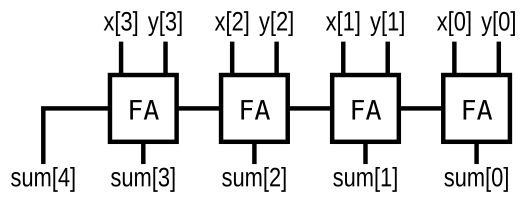
module top_module (
	input [3:0] x,
	input [3:0] y,
	output [4:0] sum
);

	// This circuit is a 4-bit ripple-carry adder with carry-out.
	assign sum = x+y;	// Verilog addition automatically produces the carry-out bit.

	// Verilog quirk: Even though the value of (x+y) includes the carry-out, (x+y) is still considered  to be a 4-bit number (The max width of the two operands).
	// This is correct:
	// assign sum = (x+y);
	//verilog语法会自动将x+y扩展成5bit数
	// But this is incorrect:
	// assign sum = {x+y};	// Concatenation operator: This discards the carry-out
endmodule
Problem 69:Signed addition overflow
关于有符号数相加的溢出问题
需要实现一个 2 进制 8bit 有符号数加法器,加法器将输入的两个 8bit 数补码相加,产生相加之和以及进位。
- 负负相加可能会溢出,正正相加可能会溢出
module top_module (
    input [7:0] a,
    input [7:0] b,
    output [7:0] s,
    output overflow
); //

    assign s = a+b;
	//下面开始判断溢出
    assign overflow =(a[7]&b[7]&~s[7])|(~a[7]&~b[7]&s[7]);//(正数相加产生溢出变成负数)|(负数相加产生溢出变成正数)
endmodule
Problem 70:100-bit binary adder
创建一个 100bit 的二进制加法器,该电路共包含 两个 100 bit 的输入和一个 cin,输出产生 sum 和 cout
module top_module(
    input [99:0] a, b,
    input cin,
    output cout,
    output [99:0] sum );
    assign {cout,sum}=a+b+cin;//位宽不同,Verilog会自动补齐

endmodule
Problem 71:4-digit BCD adder
构建一个 BCD 加法器,输入为 2 个 4bit 的 BCD 码,一个 cin,输出 sum 和 cout
给出例化:
module bcd_fadd {
    input [3:0] a,
    input [3:0] b,
    input     cin,
    output   cout,
    output [3:0] sum );
要求实例化 4 次 bcd_fadd 来创建一个 4 位 BCD 加法器,共 16bit;同样产生 sum 和 cout
module top_module(
    input [15:0] a, b,
    input cin,
    output cout,
    output [15:0] sum );
    wire [3:0] carry;
    bcd_fadd add1(.a(a[3:0])
                  ,.b(b[3:0])
                  ,.cin(cin)
                  ,.cout(carry[0])
                  ,.sum(sum[3:0])
                 );
    bcd_fadd add2(.a(a[7:4])
                  ,.b(b[7:4])
                  ,.cin(carry[0])
                  ,.cout(carry[1])
                  ,.sum(sum[7:4])
                 );
    bcd_fadd add3(.a(a[11:8])
                  ,.b(b[11:8])
                  ,.cin(carry[1])
                  ,.cout(carry[2])
                  ,.sum(sum[11:8])
                 );
    bcd_fadd add4(.a(a[15:12])
                  ,.b(b[15:12])
                  ,.cin(carry[2])
                  ,.cout(carry[3])
                  ,.sum(sum[15:12])
                 );

    assign cout=carry[3];
endmodule

 浙公网安备 33010602011771号