python3脚本调整歌词文件时间戳
场景:截取部分音乐歌词文件,对应歌词的时间要做相应调整。
例如:下方歌词文件,只需要 [00:28] 及以后的内容,而且将第一句 ( [00:28]月光 把天空照亮 )的时间改成 [00:01],那么第二句的时间应该是 [00:06],第三句的时间应该是 [00:12],以此类推
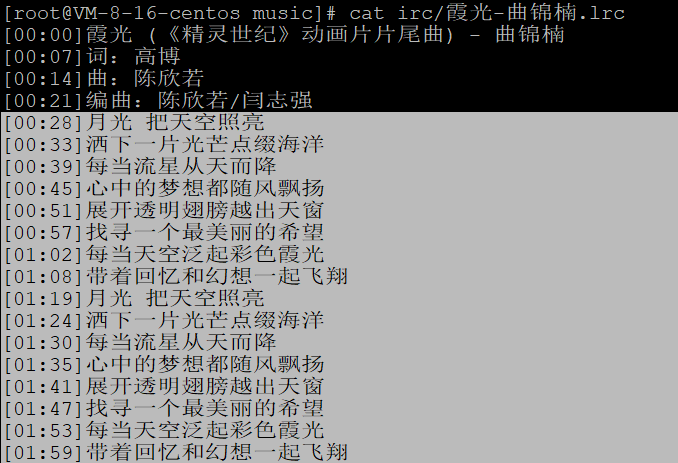
歌词文件中,时间的格式有 [mm:ss] 、[mm:ss:xx] 、[mm:ss:xxx]
[mm:ss] :这是最基本的时间戳格式,只包含分钟和秒。例如:[03:25] 表示第3分钟25秒。
[mm:ss:xx] :这个格式在分钟和秒的基础上增加了十进制的十分之一秒(即百分之一秒或10毫秒的精度)。例如:[03:25:45] 表示第3分钟25秒450毫秒。
[mm:ss:xxx] :这个格式提供了更高的精度,即毫秒级别的精度。xxx 的取值范围是 000 到 999,直接代表毫秒数。例如:[03:25:450] 也表示第3分钟25秒450毫秒。
脚本需要能兼容处理这3种时间格式,处理后的时间统一格式(我统一为[mm:ss:xx])
import re
import argparse

def adjust_lrc_from_starting_line(lrc_content, starting_line_index, new_starting_time, remove_pre_data=False):
    lines = lrc_content.split('\n')

    if starting_line_index < len(lines):
        # 编译正则表达式以匹配时间戳
        time_stamp_pattern = re.compile(r"^\[(\d+):(\d+(\.\d+)?)\s*\]")

        # 查找起始行 计算时间差
        start_match = time_stamp_pattern.search(lines[starting_line_index])
        if start_match:
            start_minutes, start_seconds_str = start_match.groups()[:2]
            start_seconds = float(start_seconds_str) if '.' in start_seconds_str else float(start_seconds_str) + 0.00  # 确保秒数有小数部分
            new_minutes, new_seconds = map(float, new_starting_time.split(':'))

            time_difference = (new_minutes * 60 + new_seconds) - (float(start_minutes) * 60 + start_seconds)

        # 更新后续行的时间戳
        for i in range(starting_line_index, len(lines)):
            match = time_stamp_pattern.search(lines[i])
            if match:
                minutes, seconds = match.groups()[:2]
                total_seconds = float(minutes) * 60 + float(seconds)
                adjusted_seconds = total_seconds + time_difference
                adjusted_minutes, adjusted_seconds = divmod(adjusted_seconds, 60)
                adjusted_time_str = f"[{adjusted_minutes:02.0f}:{adjusted_seconds:05.2f}]"

                # 只替换时间戳部分,而不是整行
                prefix, content = lines[i].split(']', 1)
                lines[i] = adjusted_time_str  + content

    # 在处理完所有行后,根据remove_pre_data的值决定是否移除起始行之前的数据
    if remove_pre_data:
        lines = lines[starting_line_index:]
    return '\n'.join(lines)

def main():
    parser = argparse.ArgumentParser(description="调整歌词时间戳")
    parser.add_argument("lrc_file", help="需要处理的歌词文件路径")
    parser.add_argument("starting_line_index", type=int, help="起始行号索引,从0开始")
    parser.add_argument("new_starting_time", help="新的起始时间格式为 'mm:ss.xx'")
    parser.add_argument("--remove-pre-data", "-r", action="store_true", help="移除起始行之前的数据", default=False)

    args = parser.parse_args()

    with open(args.lrc_file, 'r', encoding='utf-8') as file:
        lrc_content = file.read()

    new_lrc_content = adjust_lrc_from_starting_line(lrc_content, args.starting_line_index, args.new_starting_time, args.remove_pre_data)
    print(new_lrc_content)

if __name__ == "__main__":
    main()
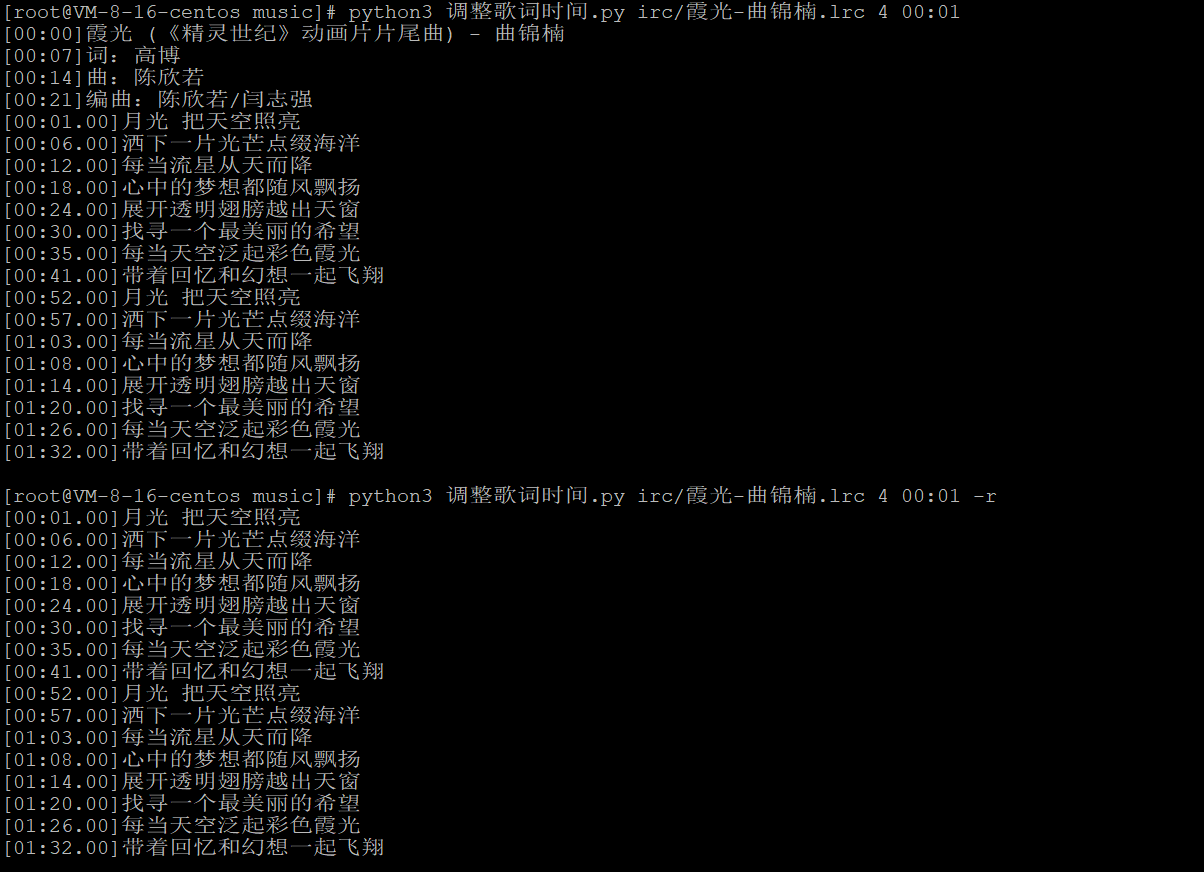
脚本的参数:歌词文件路径、起始调整行索引、调整后的时间、是否移除起始调整行之前的数据
使用效果如下:
以下为2026.02.05优化后脚本
import re
import argparse

def adjust_lrc_from_starting_line(lrc_content, starting_line_index, new_starting_time, remove_pre_data=False):
    lines = lrc_content.split('\n')

    if starting_line_index < len(lines):
        # 编译正则表达式以匹配时间戳
        time_stamp_pattern = re.compile(r"^\[(\d+):(\d+(\.\d+)?)\s*\]")

        # 查找起始行 计算时间差
        start_match = time_stamp_pattern.search(lines[starting_line_index])
        if start_match:
            start_minutes, start_seconds_str = start_match.groups()[:2]
            start_seconds = float(start_seconds_str) if '.' in start_seconds_str else float(start_seconds_str) + 0.00  # 确保秒数有小数部分
            new_minutes, new_seconds = map(float, new_starting_time.split(':'))

            time_difference = (new_minutes * 60 + new_seconds) - (float(start_minutes) * 60 + start_seconds)

        # 更新后续行的时间戳
        for i in range(starting_line_index, len(lines)):
            match = time_stamp_pattern.search(lines[i])
            if match:
                minutes, seconds = match.groups()[:2]
                total_seconds = float(minutes) * 60 + float(seconds)
                adjusted_seconds = total_seconds + time_difference
                adjusted_minutes, adjusted_seconds = divmod(adjusted_seconds, 60)
                adjusted_time_str = f"[{adjusted_minutes:02.0f}:{adjusted_seconds:05.2f}]"

                # 只替换时间戳部分,而不是整行
                prefix, content = lines[i].split(']', 1)
                lines[i] = adjusted_time_str  + content

    # 在处理完所有行后,根据remove_pre_data的值决定是否移除起始行之前的数据
    if remove_pre_data:
        lines = lines[starting_line_index:]
    return '\n'.join(lines)

def get_input_with_validation(prompt, validation_func=None, error_message=None):
    """获取用户输入,可选验证"""
    while True:
        try:
            value = input(prompt)
            if validation_func:
                value = validation_func(value)
            return value
        except Exception as e:
            if error_message:
                print(f"错误: {error_message}")
            else:
                print(f"输入无效,请重新输入。错误: {e}")

def validate_line_number(value, max_line):
    """验证行号是否在 1 到 max_line 之间,返回 1-based 行号"""
    try:
        num = int(value)
    except (ValueError, TypeError):
        raise ValueError("不是有效整数")
    if num < 1 or num > max_line:
        raise ValueError(f"行号必须在 1 到 {max_line} 之间")
    return num  # 返回 1-based 行号

def validate_time_format(value):
    """验证时间格式 mm:ss.xx"""
    if not re.match(r'^\d+:\d+(\.\d+)?$', value):
        raise ValueError("时间格式应为 'mm:ss.xx',例如 '01:23.45'")

    parts = value.split(':')
    minutes = int(parts[0])
    seconds = float(parts[1])

    if minutes < 0:
        raise ValueError("分钟数不能为负数")
    if seconds < 0 or seconds >= 60:
        raise ValueError("秒数必须在 0 到 59.99 之间")

    return value

def main():
    # 1. 文件路径
    parser = argparse.ArgumentParser(description="调整歌词时间戳")
    parser.add_argument("lrc_file", help="需要处理的歌词文件路径")
    parser.add_argument("--remove-pre-data", "-r", action="store_true", help="移除起始行之前的数据", default=False)
    args = parser.parse_args()

    with open(args.lrc_file, 'r', encoding='utf-8') as file:
        lrc_content = file.read()

    lines = lrc_content.split('\n')
    total_lines = len(lines)

    # 2. 起始行号 (1-based)
    starting_line = get_input_with_validation(
        prompt=f"\n请输入起始行号 (1-{total_lines}): ",
        validation_func=lambda x: validate_line_number(x, total_lines),
        error_message=f"请输入 1 到 {total_lines} 之间的整数"
    )

    starting_line_index = starting_line - 1  # 转为 0-based 索引

    # 3. 新的起始时间
    new_starting_time = get_input_with_validation(
        "\n请输入新的起始时间 (格式: mm:ss.xx): ",
        validate_time_format,
        "时间格式应为 'mm:ss.xx',例如 '01:23.45'"
    )

    new_lrc_content = adjust_lrc_from_starting_line(lrc_content, starting_line_index, new_starting_time, args.remove_pre_data)
    print(new_lrc_content)

if __name__ == "__main__":
    main()
效果如下


 浙公网安备 33010602011771号