
http://hellolibo.com/2013/03/01/django-cms-1/
https://code.ziqiangxuetang.com/django/django-middleware.html
MIDDLEWARE_CLASSES
django的中间件列表。在web请求到达url匹配之前,都会按列表顺序在中间列中被过滤,所以希望全局对请求做一些处理可以开发一个中间件添加到这里。安装django-cms时,有几个cms依赖的中间件必须要添加:
'cms.middleware.page.CurrentPageMiddleware',
'cms.middleware.user.CurrentUserMiddleware',
'cms.middleware.toolbar.ToolbarMiddleware',
INSTALLED_APPS
django的大部分功能是通过APP来实现的,通过此项来组装这些APP。系统会提供很多有用的APP, 我们自己也可以为一些功能开发一个独立的APP添加到这个元组中。以下为后续要用到的app列表:
'django.contrib.auth',
'django.contrib.contenttypes',
'django.contrib.sessions',
'django.contrib.sites',
'django.contrib.messages',
'django.contrib.admin',
'django.contrib.staticfiles',
'cms',
'menus',
'mptt',
'south',
'cms.plugins.text',
'cms.plugins.picture',
'cms.plugins.link',
'cms.plugins.file',
'cms.plugins.snippet',
'cms.plugins.googlemap',
'sekizai',

'tinymce',
'filebrowser',

'easy_thumbnails'
django-cms安装时也会提供一个settings的模板文件,主要是列出需要的app, 其它设置可以查看文档
======================================

也就是说,每一个请求都是先通过中间件中的 process_request 函数,这个函数返回 None 或者 HttpResponse 对象,如果返回前者,继续处理其它中间件,如果返回一个 HttpResponse,就处理中止,返回到网页上。
原理跟apache的hook机制类似嘛
中间件不用继承自任何类(可以继承 object ),下面一个中间件大概的样子:
|
1
2
3
4
5
6
|
class CommonMiddleware(object): def process_request(self, request): return None def process_response(self, request, response): return response |
还有 process_view, process_exception 和 process_template_response 函数。
一,比如我们要做一个 拦截器,发现有恶意访问网站的人,就拦截他!
假如我们通过一种技术,比如统计一分钟访问页面数,太多就把他的 IP 加入到黑名单 BLOCKED_IPS(这部分没有提供代码,主要讲中间件部分)
|
1
2
3
4
5
6
|
#项目 zqxt 文件名 zqxt/middleware.pyclass BlockedIpMiddleware(object): def process_request(self, request): if request.META['REMOTE_ADDR'] in getattr(settings, "BLOCKED_IPS", []): return http.HttpResponseForbidden('<h1>Forbidden</h1>') |
这里的代码的功能就是 获取当前访问者的 IP (request.META['REMOTE_ADDR']),如果这个 IP 在黑名单中就拦截,如果不在就返回 None (函数中没有返回值其实就是默认为 None),把这个中间件的 Python 路径写到settings.py中
1.1 Django 1.9 和以前的版本:
|
1
2
3
4
|
MIDDLEWARE_CLASSES = ( 'zqxt.middleware.BlockedIpMiddleware', ...其它的中间件) |
1.2 Django 1.10 版本 更名为 MIDDLEWARE(单复同形),写法也有变化,详见 第四部分。
如果用 Django 1.10版本开发,部署时用 Django 1.9版本或更低版本,要特别小心此处。
|
1
2
3
4
|
MIDDLEWARE = ( 'zqxt.middleware.BlockedIpMiddleware', ...其它的中间件) |
Django 会从 MIDDLEWARE_CLASSES 或 MIDDLEWARE 中按照从上到下的顺序一个个执行中间件中的 process_request 函数,而其中 process_response 函数则是最前面的最后执行。(见上图,按序处理)
二,再比如,我们在网站放到服务器上正式运行后,DEBUG改为了 False,这样更安全,但是有时候发生错误我们不能看到错误详情,调试不方便,有没有办法处理好这两个事情呢?
-
普通访问者看到的是友好的报错信息
-
管理员看到的是错误详情,以便于修复 BUG
当然可以有,利用中间件就可以做到!代码如下:
|
1
2
3
4
5
6
7
8
|
import sysfrom django.views.debug import technical_500_responsefrom django.conf import settingsclass UserBasedExceptionMiddleware(object): def process_exception(self, request, exception): if request.user.is_superuser or request.META.get('REMOTE_ADDR') in settings.INTERNAL_IPS: return technical_500_response(request, *sys.exc_info()) |
把这个中间件像上面一样,加到你的 settings.py 中的 MIDDLEWARE_CLASSES 中,可以放到最后,这样可以看到其它中间件的 process_request的错误。
当访问者为管理员时,就给出错误详情,比如访问本站的不存在的页面:http://www.ziqiangxuetang.com/admin/
普通人看到的是普通的 404(自己点开看看),而我可以看到:
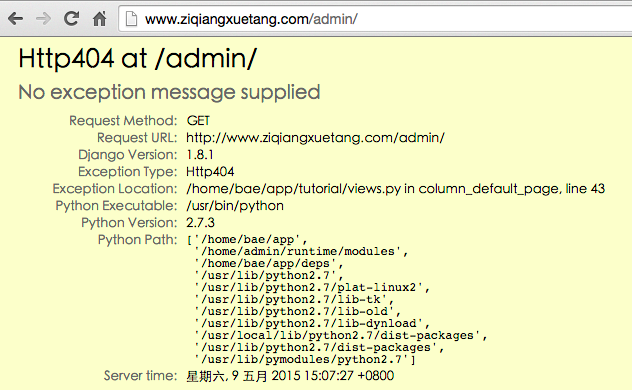
三,分享一个简单的识别手机的中间件,更详细的可以参考这个:django-mobi 或 django-mobile
|
1
2
3
4
5
6
7
8
9
10
11
12
13
14
15
16
17
18
19
20
21
22
23
24
25
26
27
28
29
30
31
32
33
34
35
|
MOBILE_USERAGENTS = ("2.0 MMP","240x320","400X240","AvantGo","BlackBerry", "Blazer","Cellphone","Danger","DoCoMo","Elaine/3.0","EudoraWeb", "Googlebot-Mobile","hiptop","IEMobile","KYOCERA/WX310K","LG/U990", "MIDP-2.","MMEF20","MOT-V","NetFront","Newt","Nintendo Wii","Nitro", "Nokia","Opera Mini","Palm","PlayStation Portable","portalmmm","Proxinet", "ProxiNet","SHARP-TQ-GX10","SHG-i900","Small","SonyEricsson","Symbian OS", "SymbianOS","TS21i-10","UP.Browser","UP.Link","webOS","Windows CE", "WinWAP","YahooSeeker/M1A1-R2D2","iPhone","iPod","Android", "BlackBerry9530","LG-TU915 Obigo","LGE VX","webOS","Nokia5800")class MobileTemplate(object): """ If a mobile user agent is detected, inspect the default args for the view func, and if a template name is found assume it is the template arg and attempt to load a mobile template based on the original template name. """ def process_view(self, request, view_func, view_args, view_kwargs): if any(ua for ua in MOBILE_USERAGENTS if ua in request.META["HTTP_USER_AGENT"]): template = view_kwargs.get("template") if template is None: for default in view_func.func_defaults: if str(default).endswith(".html"): template = default if template is not None: template = template.rsplit(".html", 1)[0] + ".mobile.html" try: get_template(template) except TemplateDoesNotExist: pass else: view_kwargs["template"] = template return view_func(request, *view_args, **view_kwargs) return None |
参考文档:https://docs.djangoproject.com/en/1.8/topics/http/middleware/
四,补充:Django 1.10 接口发生变化,变得更加简洁
|
1
2
3
4
5
6
7
8
9
10
11
12
13
14
15
16
17
|
class SimpleMiddleware(object): def __init__(self, get_response): self.get_response = get_response # One-time configuration and initialization. def __call__(self, request): # Code to be executed for each request before # the view (and later middleware) are called. # 调用 view 之前的代码 response = self.get_response(request) # Code to be executed for each request/response after # the view is called. # 调用 view 之后的代码 return response |
Django 1.10.x 也可以用函数来实现中间件,详见官方文档。
五,让 你写的中间件 兼容 Django新版本和旧版本
|
1
2
3
4
5
6
7
8
9
10
11
12
|
try: from django.utils.deprecation import MiddlewareMixin # Django 1.10.xexcept ImportError: MiddlewareMixin = object # Django 1.4.x - Django 1.9.xclass SimpleMiddleware(MiddlewareMixin): def process_request(self, request): pass def process_response(request, response): pass |
新版本中 django.utils.deprecation.MiddlewareMixin 的 源代码 如下:
|
1
2
3
4
5
6
7
8
9
10
11
12
13
14
|
class MiddlewareMixin(object): def __init__(self, get_response=None): self.get_response = get_response super(MiddlewareMixin, self).__init__() def __call__(self, request): response = None if hasattr(self, 'process_request'): response = self.process_request(request) if not response: response = self.get_response(request) if hasattr(self, 'process_response'): response = self.process_response(request, response) return response |
__call__ 方法会先调用 self.process_request(request),接着执行 self.get_response(request) 然后调用 self.process_response(request, response)
旧版本(Django 1.4.x-Django 1.9.x) 的话,和原来一样。

 浙公网安备 33010602011771号