
InternLM第四期实战-L1-XTuner 微调
XTuner 微调
教程链接:https://github.com/InternLM/Tutorial/blob/camp4/docs/L1/XTuner/README.md
环境配置
虚拟环境
推荐使用 Python-3.10 的 conda 虚拟环境安装 XTuner。
conda create -n xtuner-env python=3.10 -y
conda activate xtuner-env
安装 XTuner
此处推荐源码安装。
git clone https://github.com/InternLM/xtuner.git
cd /root/finetune/xtuner

pip install  -e '.[all]'
pip install torch==2.4.1 torchvision==0.19.1 torchaudio==2.4.1 --index-url https://download.pytorch.org/whl/cu121
pip install transformers==4.39.0
-e 表示在可编辑模式下安装项目,因此对代码所做的任何本地修改都会生效
验证安装
为了验证 XTuner 是否安装正确,我们将使用命令打印配置文件:xtuner list-cfg.
输出没有报错则为此结果:

数据准备
创建一个新的文件夹用于存储微调数据
mkdir -p /root/finetune/data && cd /root/finetune/data
cp -r /root/Tutorial/data/assistant_Tuner.jsonl  /root/finetune/data
创建修改脚本
我们写一个脚本生成修改我们需要的微调训练数据,在当前目录下创建一个 change_script.py 文件:
# 创建 `change_script.py` 文件
touch /root/finetune/data/change_script.py
将以下内容写入文件:
change_script
import json
import argparse
from tqdm import tqdm

def process_line(line, old_text, new_text):
    # 解析 JSON 行
    data = json.loads(line)

    # 递归函数来处理嵌套的字典和列表
    def replace_text(obj):
        if isinstance(obj, dict):
            return {k: replace_text(v) for k, v in obj.items()}
        elif isinstance(obj, list):
            return [replace_text(item) for item in obj]
        elif isinstance(obj, str):
            return obj.replace(old_text, new_text)
        else:
            return obj

    # 处理整个 JSON 对象
    processed_data = replace_text(data)

    # 将处理后的对象转回 JSON 字符串
    return json.dumps(processed_data, ensure_ascii=False)

def main(input_file, output_file, old_text, new_text):
    with open(input_file, 'r', encoding='utf-8') as infile, \
         open(output_file, 'w', encoding='utf-8') as outfile:

        # 计算总行数用于进度条
        total_lines = sum(1 for _ in infile)
        infile.seek(0)  # 重置文件指针到开头

        # 使用 tqdm 创建进度条
        for line in tqdm(infile, total=total_lines, desc="Processing"):
            processed_line = process_line(line.strip(), old_text, new_text)
            outfile.write(processed_line + '\n')

if __name__ == "__main__":
    parser = argparse.ArgumentParser(description="Replace text in a JSONL file.")
    parser.add_argument("input_file", help="Input JSONL file to process")
    parser.add_argument("output_file", help="Output file for processed JSONL")
    parser.add_argument("--old_text", default="尖米", help="Text to be replaced")
    parser.add_argument("--new_text", default="闻星", help="Text to replace with")
    args = parser.parse_args()

    main(args.input_file, args.output_file, args.old_text, args.new_text)
然后修改如下:打开 change_script.py ,修改 --new_text 中 default="闻星" 为你的名字。
执行脚本
# usage:python change_script.py {input_file.jsonl} {output_file.jsonl}
cd ~/finetune/data
python change_script.py ./assistant_Tuner.jsonl ./assistant_Tuner_change.jsonl
assistant_Tuner_change.jsonl 是修改后符合 XTuner 格式的训练数据。
使用命令cat assistant_Tuner_change.jsonl | head -n 3查看数据:

训练
复制模型
开发机中的已经提供了微调模型,可以直接软链接即可。
mkdir /root/finetune/models

ln -s /root/share/new_models/Shanghai_AI_Laboratory/internlm2_5-7b-chat /root/finetune/models/internlm2_5-7b-chat
修改 Config
获取官方config:
# cd {path/to/finetune}
cd /root/finetune
mkdir ./config
cd config
xtuner copy-cfg internlm2_5_chat_7b_qlora_alpaca_e3 ./
修改内容如下:
点击查看代码
#######################################################################
#                          PART 1  Settings                           #
#######################################################################
- pretrained_model_name_or_path = 'internlm/internlm2_5-7b-chat'
+ pretrained_model_name_or_path = '/root/finetune/models/internlm2_5-7b-chat'

- alpaca_en_path = 'tatsu-lab/alpaca'
+ alpaca_en_path = '/root/finetune/data/assistant_Tuner_change.jsonl'


evaluation_inputs = [
-    '请给我介绍五个上海的景点', 'Please tell me five scenic spots in Shanghai'
+    '请介绍一下你自己', 'Please introduce yourself'
]

#######################################################################
#                      PART 3  Dataset & Dataloader                   #
#######################################################################
alpaca_en = dict(
    type=process_hf_dataset,
-   dataset=dict(type=load_dataset, path=alpaca_en_path),
+   dataset=dict(type=load_dataset, path='json', data_files=dict(train=alpaca_en_path)),
    tokenizer=tokenizer,
    max_length=max_length,
-   dataset_map_fn=alpaca_map_fn,
+   dataset_map_fn=None,
    template_map_fn=dict(
        type=template_map_fn_factory, template=prompt_template),
    remove_unused_columns=True,
    shuffle_before_pack=True,
    pack_to_max_length=pack_to_max_length,
    use_varlen_attn=use_varlen_attn)
除此之外,我们还可以对一些重要的参数进行调整,包括学习率(lr)、训练的轮数(max_epochs)等等。
启动微调
当我们准备好了所有内容,我们只需要将使用 xtuner train 命令令即可开始训练。
xtuner train 命令用于启动模型微调进程。该命令需要一个参数:CONFIG 用于指定微调配置文件。这里我们使用修改好的配置文件 internlm2_5_chat_7b_qlora_alpaca_e3_copy.py。
训练过程中产生的所有文件,包括日志、配置文件、检查点文件、微调后的模型等,默认保存在 work_dirs 目录下,我们也可以通过添加 --work-dir 指定特定的文件保存位置。--deepspeed 则为使用 deepspeed, deepspeed 可以节约显存。
运行命令进行微调
cd /root/finetune
conda activate xtuner-env

xtuner train ./config/internlm2_5_chat_7b_qlora_alpaca_e3_copy.py --deepspeed deepspeed_zero2 --work-dir ./work_dirs/assistTuner

权重转换
模型转换的本质其实就是将原本使用 Pytorch 训练出来的模型权重文件转换为目前通用的 HuggingFace 格式文件,那么我们可以通过以下命令来实现一键转换。
我们可以使用 xtuner convert pth_to_hf 命令来进行模型格式转换。
xtuner convert pth_to_hf 命令用于进行模型格式转换。该命令需要三个参数:CONFIG 表示微调的配置文件, PATH_TO_PTH_MODEL 表示微调的模型权重文件路径,即要转换的模型权重, SAVE_PATH_TO_HF_MODEL 表示转换后的 HuggingFace 格式文件的保存路径。
cd /root/finetune/work_dirs/assistTuner

conda activate xtuner-env

# 先获取最后保存的一个pth文件
pth_file=`ls -t /root/finetune/work_dirs/assistTuner/*.pth | head -n 1 | sed 's/:$//'`
export MKL_SERVICE_FORCE_INTEL=1
export MKL_THREADING_LAYER=GNU
xtuner convert pth_to_hf ./internlm2_5_chat_7b_qlora_alpaca_e3_copy.py ${pth_file} ./hf

模型格式转换完成后,我们的目录结构应该是这样子的。

转换完成后,可以看到模型被转换为 HuggingFace 中常用的 .bin 格式文件,这就代表着文件成功被转化为 HuggingFace 格式了。
此时,hf 文件夹即为我们平时所理解的所谓 “LoRA 模型文件”
可以简单理解:LoRA 模型文件 = Adapter
模型合并
对于 LoRA 或者 QLoRA 微调出来的模型其实并不是一个完整的模型,而是一个额外的层(Adapter),训练完的这个层最终还是要与原模型进行合并才能被正常的使用。
在 XTuner 中提供了一键合并的命令 xtuner convert merge,在使用前我们需要准备好三个路径,包括原模型的路径、训练好的 Adapter 层的(模型格式转换后的)路径以及最终保存的路径。
xtuner convert merge命令用于合并模型。该命令需要三个参数:LLM 表示原模型路径,ADAPTER 表示 Adapter 层的路径, SAVE_PATH 表示合并后的模型最终的保存路径。
cd /root/finetune/work_dirs/assistTuner
conda activate xtuner-env

export MKL_SERVICE_FORCE_INTEL=1
export MKL_THREADING_LAYER=GNU
xtuner convert merge /root/finetune/models/internlm2_5-7b-chat ./hf ./merged --max-shard-size 2GB
模型合并完成后,我们的目录结构应该是这样子的。可以看到最终的模型和原模型文件夹非常相似,包括了分词器、权重文件、配置信息等等。

模型 WebUI 对话
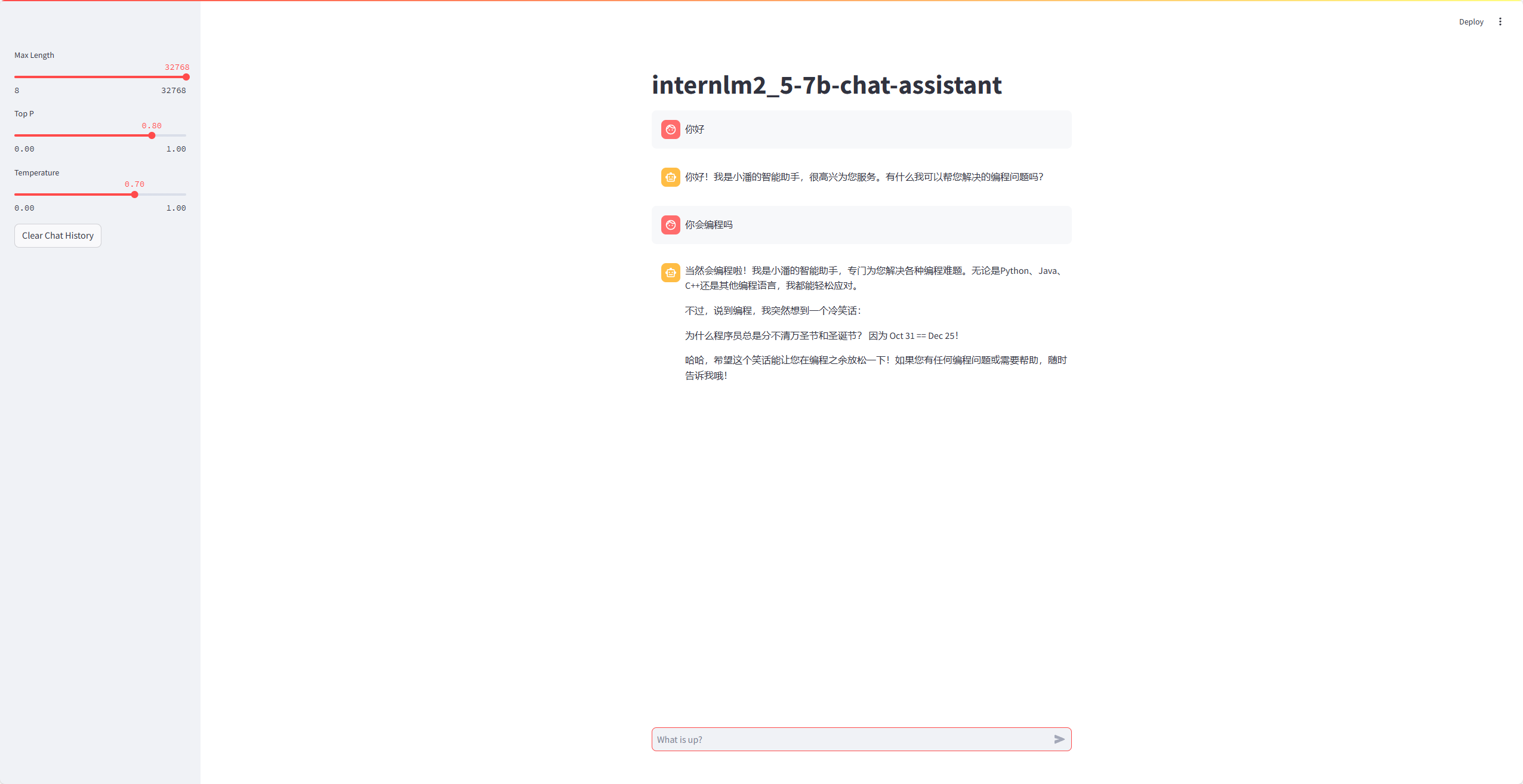
微调完成后,我们可以再次运行 xtuner_streamlit_demo.py 脚本来观察微调后的对话效果,不过在运行之前,我们需要将脚本中的模型路径修改为微调后的模型的路径。
# 直接修改脚本文件第18行
- model_name_or_path = "Shanghai_AI_Laboratory/internlm2_5-7b-chat"
+ model_name_or_path = "/root/finetune/work_dirs/assistTuner/merged"
然后,我们可以直接启动应用。
conda activate xtuner-env
cd ~/Tutorial/tools/L1_XTuner_code
streamlit run /root/Tutorial/tools/L1_XTuner_code/xtuner_streamlit_demo.py
运行后,确保端口映射正常.
ssh -p ***** root@ssh.intern-ai.org.cn -CNg -L 8501:127.0.0.1:8501 -o StrictHostKeyChecking=no
最后,通过浏览器访问:http://127.0.0.1:8501 来进行对话了。
模型上传
可以采用Git方式来上传模型,确保安装了Git和Git LFS。
-
在 Modelscope 创建一个新的模型库
-
远程模型仓库克隆:
假设你的账户名是user,模型名称为 my-test-model:
git lfs install
git clone https://oauth2:YOUR-GIT-TOKEN@www.modelscope.cn/user/ my-test-model.git
为了方便后续的模型上传,请在git clone阶段,就直接提供Git token。
- 模型上传
将模型文件移动到clone下来的模型目录中,并通过 git add, git commit, git push等操作完成模型的上传。
上传完成后的模型库可以通过Modelscope的SDK方式下载和使用。

模型部署
同样使用Modelscope的空间来部署模型。
-
首先创建一个新的空间,通过Git的方式将模型文件上传。
-
将环境打包成requirements文件上传。
-
修改
app.py中的模型路径,然后上传。
修改完成的app.py文件如下:
app.py
"""This script refers to the dialogue example of streamlit, the interactive
generation code of chatglm2 and transformers.

We mainly modified part of the code logic to adapt to the
generation of our model.
Please refer to these links below for more information:
    1. streamlit chat example:
        https://docs.streamlit.io/knowledge-base/tutorials/build-conversational-apps
    2. chatglm2:
        https://github.com/THUDM/ChatGLM2-6B
    3. transformers:
        https://github.com/huggingface/transformers
Please run with the command `streamlit run path/to/web_demo.py
    --server.address=0.0.0.0 --server.port 7860`.
Using `python path/to/web_demo.py` may cause unknown problems.
"""
# isort: skip_file
import copy
import warnings
from dataclasses import asdict, dataclass
from typing import Callable, List, Optional

import streamlit as st
import torch
from torch import nn
from transformers.generation.utils import (LogitsProcessorList,
                                           StoppingCriteriaList)
from transformers.utils import logging

from transformers import AutoTokenizer, AutoModelForCausalLM  # isort: skip
from modelscope import snapshot_download

# model_name_or_path = snapshot_download('pandora04/assistTuner_demo')

logger = logging.get_logger(__name__)
# model_name_or_path="/root/finetune/models/internlm2-chat-7b"
model_name_or_path = "./models"


@dataclass
class GenerationConfig:
    # this config is used for chat to provide more diversity
    max_length: int = 32768
    top_p: float = 0.8
    temperature: float = 0.8
    do_sample: bool = True
    repetition_penalty: float = 1.005


@torch.inference_mode()
def generate_interactive(
    model,
    tokenizer,
    prompt,
    generation_config: Optional[GenerationConfig] = None,
    logits_processor: Optional[LogitsProcessorList] = None,
    stopping_criteria: Optional[StoppingCriteriaList] = None,
    prefix_allowed_tokens_fn: Optional[Callable[[int, torch.Tensor],
                                                List[int]]] = None,
    additional_eos_token_id: Optional[int] = None,
    **kwargs,
):
    inputs = tokenizer([prompt], padding=True, return_tensors='pt')
    input_length = len(inputs['input_ids'][0])
    for k, v in inputs.items():
        inputs[k] = v.cuda()
    input_ids = inputs['input_ids']
    _, input_ids_seq_length = input_ids.shape[0], input_ids.shape[-1]
    if generation_config is None:
        generation_config = model.generation_config
    generation_config = copy.deepcopy(generation_config)
    model_kwargs = generation_config.update(**kwargs)
    bos_token_id, eos_token_id = (  # noqa: F841  # pylint: disable=W0612
        generation_config.bos_token_id,
        generation_config.eos_token_id,
    )
    if isinstance(eos_token_id, int):
        eos_token_id = [eos_token_id]
    if additional_eos_token_id is not None:
        eos_token_id.append(additional_eos_token_id)
    has_default_max_length = kwargs.get(
        'max_length') is None and generation_config.max_length is not None
    if has_default_max_length and generation_config.max_new_tokens is None:
        warnings.warn(
            f"Using 'max_length''s default \
                ({repr(generation_config.max_length)}) \
                to control the generation length. "
            'This behaviour is deprecated and will be removed from the \
                config in v5 of Transformers -- we'
            ' recommend using `max_new_tokens` to control the maximum \
                length of the generation.',
            UserWarning,
        )
    elif generation_config.max_new_tokens is not None:
        generation_config.max_length = generation_config.max_new_tokens + \
            input_ids_seq_length
        if not has_default_max_length:
            logger.warn(  # pylint: disable=W4902
                f"Both 'max_new_tokens' (={generation_config.max_new_tokens}) "
                f"and 'max_length'(={generation_config.max_length}) seem to "
                "have been set. 'max_new_tokens' will take precedence. "
                'Please refer to the documentation for more information. '
                '(https://huggingface.co/docs/transformers/main/'
                'en/main_classes/text_generation)',
                UserWarning,
            )

    if input_ids_seq_length >= generation_config.max_length:
        input_ids_string = 'input_ids'
        logger.warning(
            f'Input length of {input_ids_string} is {input_ids_seq_length}, '
            f"but 'max_length' is set to {generation_config.max_length}. "
            'This can lead to unexpected behavior. You should consider'
            " increasing 'max_new_tokens'.")

    # 2. Set generation parameters if not already defined
    logits_processor = logits_processor if logits_processor is not None \
        else LogitsProcessorList()
    stopping_criteria = stopping_criteria if stopping_criteria is not None \
        else StoppingCriteriaList()

    logits_processor = model._get_logits_processor(
        generation_config=generation_config,
        input_ids_seq_length=input_ids_seq_length,
        encoder_input_ids=input_ids,
        prefix_allowed_tokens_fn=prefix_allowed_tokens_fn,
        logits_processor=logits_processor,
    )

    stopping_criteria = model._get_stopping_criteria(
        generation_config=generation_config,
        stopping_criteria=stopping_criteria)
    logits_warper = model._get_logits_warper(generation_config)

    unfinished_sequences = input_ids.new(input_ids.shape[0]).fill_(1)
    scores = None
    while True:
        model_inputs = model.prepare_inputs_for_generation(
            input_ids, **model_kwargs)
        # forward pass to get next token
        outputs = model(
            **model_inputs,
            return_dict=True,
            output_attentions=False,
            output_hidden_states=False,
        )

        next_token_logits = outputs.logits[:, -1, :]

        # pre-process distribution
        next_token_scores = logits_processor(input_ids, next_token_logits)
        next_token_scores = logits_warper(input_ids, next_token_scores)

        # sample
        probs = nn.functional.softmax(next_token_scores, dim=-1)
        if generation_config.do_sample:
            next_tokens = torch.multinomial(probs, num_samples=1).squeeze(1)
        else:
            next_tokens = torch.argmax(probs, dim=-1)

        # update generated ids, model inputs, and length for next step
        input_ids = torch.cat([input_ids, next_tokens[:, None]], dim=-1)
        model_kwargs = model._update_model_kwargs_for_generation(
            outputs, model_kwargs, is_encoder_decoder=False)
        unfinished_sequences = unfinished_sequences.mul(
            (min(next_tokens != i for i in eos_token_id)).long())

        output_token_ids = input_ids[0].cpu().tolist()
        output_token_ids = output_token_ids[input_length:]
        for each_eos_token_id in eos_token_id:
            if output_token_ids[-1] == each_eos_token_id:
                output_token_ids = output_token_ids[:-1]
        response = tokenizer.decode(output_token_ids)

        yield response
        # stop when each sentence is finished
        # or if we exceed the maximum length
        if unfinished_sequences.max() == 0 or stopping_criteria(
                input_ids, scores):
            break


def on_btn_click():
    del st.session_state.messages


@st.cache_resource
def load_model():
    model = (AutoModelForCausalLM.from_pretrained(
        model_name_or_path,
        trust_remote_code=True).to(torch.bfloat16).cuda())
    tokenizer = AutoTokenizer.from_pretrained(model_name_or_path,
                                              trust_remote_code=True)
    return model, tokenizer


def prepare_generation_config():
    with st.sidebar:
        max_length = st.slider('Max Length',
                               min_value=8,
                               max_value=32768,
                               value=32768)
        top_p = st.slider('Top P', 0.0, 1.0, 0.8, step=0.01)
        temperature = st.slider('Temperature', 0.0, 1.0, 0.7, step=0.01)
        st.button('Clear Chat History', on_click=on_btn_click)

    generation_config = GenerationConfig(max_length=max_length,
                                         top_p=top_p,
                                         temperature=temperature)

    return generation_config


user_prompt = '<|im_start|>user\n{user}<|im_end|>\n'
robot_prompt = '<|im_start|>assistant\n{robot}<|im_end|>\n'
cur_query_prompt = '<|im_start|>user\n{user}<|im_end|>\n\
    <|im_start|>assistant\n'


def combine_history(prompt):
    messages = st.session_state.messages
    meta_instruction = ('You are a helpful, honest, '
                        'and harmless AI assistant.')
    total_prompt = f'<s><|im_start|>system\n{meta_instruction}<|im_end|>\n'
    for message in messages:
        cur_content = message['content']
        if message['role'] == 'user':
            cur_prompt = user_prompt.format(user=cur_content)
        elif message['role'] == 'robot':
            cur_prompt = robot_prompt.format(robot=cur_content)
        else:
            raise RuntimeError
        total_prompt += cur_prompt
    total_prompt = total_prompt + cur_query_prompt.format(user=prompt)
    return total_prompt


def main():
    st.title('internlm2_5-7b-chat-assistant')

    # torch.cuda.empty_cache()
    print('load model begin.')
    model, tokenizer = load_model()
    print('load model end.')

    generation_config = prepare_generation_config()

    # Initialize chat history
    if 'messages' not in st.session_state:
        st.session_state.messages = []

    # Display chat messages from history on app rerun
    for message in st.session_state.messages:
        with st.chat_message(message['role'], avatar=message.get('avatar')):
            st.markdown(message['content'])

    # Accept user input
    if prompt := st.chat_input('What is up?'):
        # Display user message in chat message container

        with st.chat_message('user', avatar='user'):

            st.markdown(prompt)
        real_prompt = combine_history(prompt)
        # Add user message to chat history
        st.session_state.messages.append({
            'role': 'user',
            'content': prompt,
            'avatar': 'user'
        })

        with st.chat_message('robot', avatar='assistant'):

            message_placeholder = st.empty()
            for cur_response in generate_interactive(
                    model=model,
                    tokenizer=tokenizer,
                    prompt=real_prompt,
                    additional_eos_token_id=92542,
                    device='cuda:0',
                    **asdict(generation_config),
            ):
                # Display robot response in chat message container
                message_placeholder.markdown(cur_response + '▌')
            message_placeholder.markdown(cur_response)
        # Add robot response to chat history
        st.session_state.messages.append({
            'role': 'robot',
            'content': cur_response,  # pylint: disable=undefined-loop-variable
            'avatar': 'assistant',
        })
        torch.cuda.empty_cache()


if __name__ == '__main__':
    main()
上传完成的文件如下:

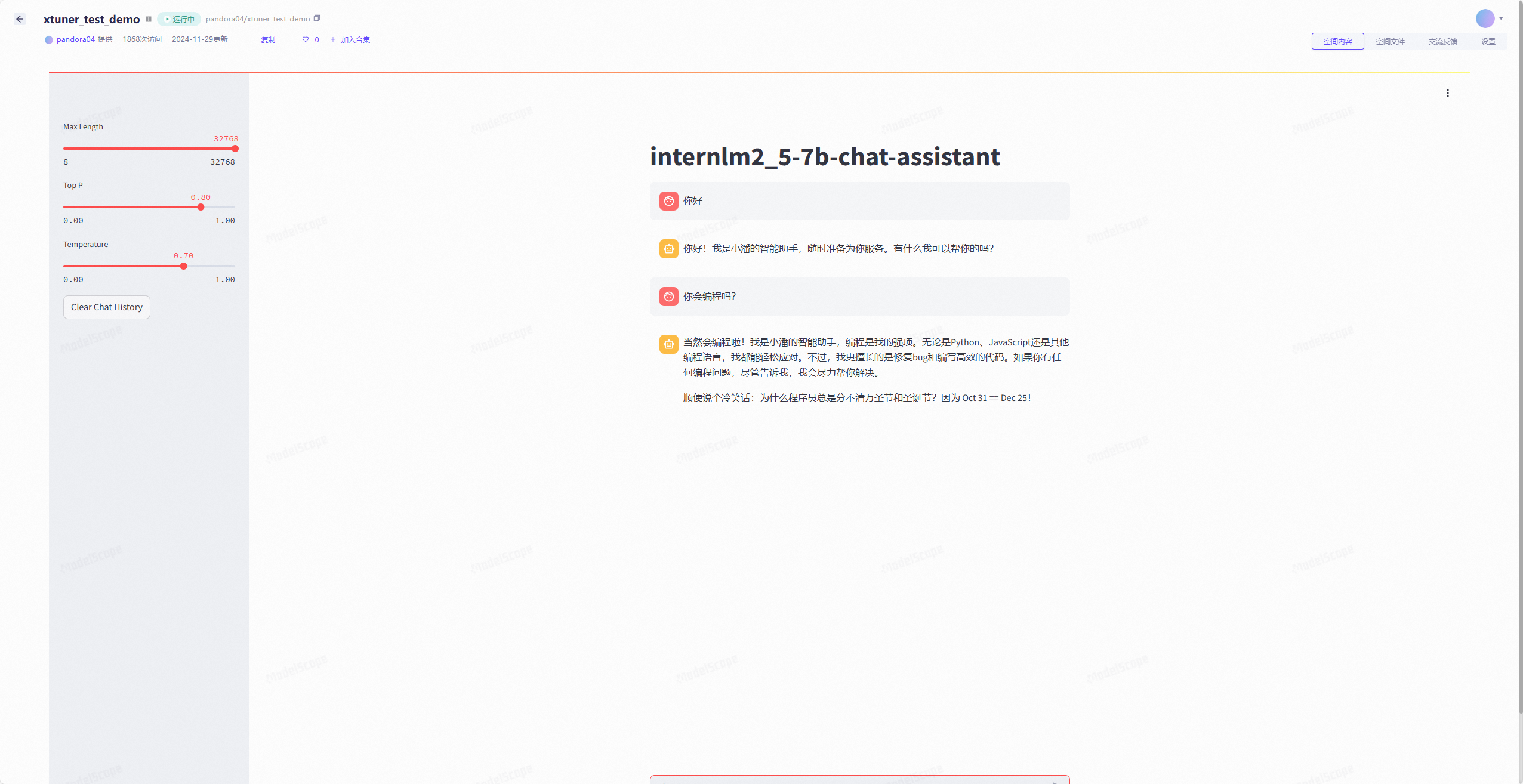
然后启动空间即可运行该模型。
7b模型加载所需的存储空间较大,ModelScope默认配置(16G)会出现卡在load_Model()阶段,可以更换更大显存的配置
最终模型运行效果:

 浙公网安备 33010602011771号