
五、 Python可视化库Seaborn
本节内容:
- Seaborn简介
- 整体布局风格设置
- 风格细节设置
- 调色板
- 调色板颜色设置
- 单变量分析绘图
- 回归分析绘图
- 多变量分析绘图
- 分类属性绘图
- Facetgrid使用方法
- Facetgrid绘制多变量
- 热度图绘制
1、Seaborn简介
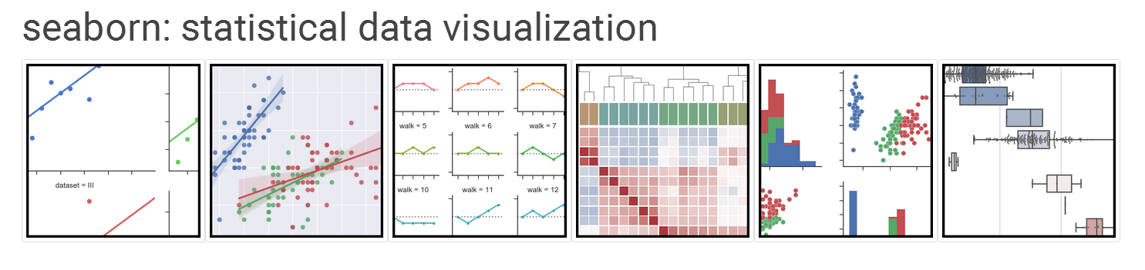
对matplotlib进行了封装,含许多的模板,绘图时简单调用模板即可。
安装Seaborn这个库:
打开anaconda prompt,输入 pip install seaborn指令。
2、整体布局风格设置
import seaborn as sns
import numpy as np
import matplotlib as mpl
import matplotlib.pyplot as plt
%matplotlib inline
#直接把图显示在我们的notebook上面

###
###
def sinplott(flip=1):
    x = np.linspace(0, 14, 100)  #在0—14之间均匀的生成100个点
    for i in range(1, 7):
        plt.plot(x, np.sin(x + i * .5) * (7 - i) * flip)  #调用一个sin函数进行画图
sinplot()

###

###
sns.set()  #调用seaborn这个库,看一下默认情况下生成的图形
sinplot()

###

###
在seaborn库中有5种主题风格的库供大家选择:
- darkgrid
- whitegrid
- dark
- white
- ticks
sns.set_style("whitegrid")
data = np.random.normal(size=(20, 6)) + np.arange(6) / 2
sns.boxplot(data=data)

###

###
sns.set_style("dark") sinplot() ###![]()

###
sns.set_style("white") sinplot() ###![]()

###
sns.set_style("ticks")
sinplot()

###

###
sinplot()
sns.despine()

###

###
3、风格细节设置
#f, ax = plt.subplots()
sns.violinplot(data)
sns.despine(offset=10)  #通过offset指定图与轴线之间的距离,指定的值越大,距离越远

###

###
sns.set_style("whitegrid")
sns.boxplot(data=data, palette="deep")
sns.despine(left=True)  #把左边的轴线去掉,左右上下都可通过设置参数来决定是否把轴线去掉

###

###
with sns.axes_style("darkgrid"):
    plt.subplot(211)
    sinplot()
plt.subplot(212)
sinplot(-1)
#生成两种不同风格的图形

###

###
sns.set()#默认设置
sns.set_context("paper")
plt.figure(figsize=(8, 6))
sinplot()
###

###
sns.set_context("talk")
plt.figure(figsize=(8, 6))
sinplot()

###

###
sns.set_context("poster")
plt.figure(figsize=(8, 6))
sinplot()

###

###
sns.set_context("notebook", font_scale=1.5, rc={"lines.linewidth": 2.5})
sinplot()

###

###
4、调色板
import numpy as np
import seaborn as sns
import matplotlib.pyplot as plt
%matplotlib inline
sns.set(rc={"figure.figsize": (6, 6)})
- 颜色很重要
- color_palette()能传入任何Matplotlib所支持的颜色
- color_palette()不写参数则默认颜色
- set_palette()设置所有图的颜色
分类色板:
current_palette = sns.color_palette()
sns.palplot(current_palette)

###

6个默认的颜色循环主题: deep, muted, pastel, bright, dark, colorblind
###
圆形画板:
当你有六个以上的分类要区分时,最简单的方法就是在一个圆形的颜色空间中画出均匀间隔的颜色(这样的色调会保持亮度和饱和度不变)。这是大多数的当他们需要使用比当前默认颜色循环中设置的颜色更多时的默认方案。
最常用的方法是使用hls的颜色空间,这是RGB值的一个简单转换。
sns.palplot(sns.color_palette("hls", 8))

###

###
data = np.random.normal(size=(20, 8)) + np.arange(8) / 2
sns.boxplot(data=data,palette=sns.color_palette("hls", 8))

###

###
hls_palette()函数来控制颜色的亮度和饱和
- l-亮度 lightness
- s-饱和 saturation
sns.palplot(sns.hls_palette(8, l=.7, s=.9))

###

###
sns.palplot(sns.color_palette("Paired",8))

###

###
4、调色板颜色设置
使用xkcd颜色来命名颜色
xkcd包含了一套众包努力的针对随机RGB色的命名。产生了954个可以随时通过xdcd_rgb字典中调用的命名颜色。
plt.plot([0, 1], [0, 1], sns.xkcd_rgb["pale red"], lw=3)
plt.plot([0, 1], [0, 2], sns.xkcd_rgb["medium green"], lw=3)
plt.plot([0, 1], [0, 3], sns.xkcd_rgb["denim blue"], lw=3)

###

###
colors = ["windows blue", "amber", "greyish", "faded green", "dusty purple"]
sns.palplot(sns.xkcd_palette(colors))

###

###
连续色板
色彩随数据变换,比如数据越来越重要则颜色越来越深
sns.palplot(sns.color_palette("Blues"))

###
 ###
###
如果想要翻转渐变,可以在面板名称中添加一个_r后缀
sns.palplot(sns.color_palette("BuGn_r"))

###

###
cubehelix_palette()调色板
色调线性变换
sns.palplot(sns.color_palette("cubehelix", 8))

###

###
sns.palplot(sns.cubehelix_palette(8, start=.5, rot=-.75))

###

###
sns.palplot(sns.cubehelix_palette(8, start=.75, rot=-.150))

###

###
light_palette() 和dark_palette()调用定制连续调色板
sns.palplot(sns.light_palette("green"))

###

###
sns.palplot(sns.dark_palette("purple"))
###

###
sns.palplot(sns.light_palette("navy", reverse=True))

###

###
x, y = np.random.multivariate_normal([0, 0], [[1, -.5], [-.5, 1]], size=300).T
pal = sns.dark_palette("green", as_cmap=True)
sns.kdeplot(x, y, cmap=pal);

###

###
sns.palplot(sns.light_palette((210, 90, 60), input="husl"))
###

###
6、单变量分析绘图
%matplotlib inline
import numpy as np
import pandas as pd
from scipy import stats, integrate
import matplotlib.pyplot as plt

import seaborn as sns
sns.set(color_codes=True)
np.random.seed(sum(map(ord, "distributions")))

###

###
x = np.random.normal(size=100)
sns.distplot(x,kde=False)

###

###
sns.distplot(x, bins=20, kde=False)

###

###
数据分布情况:
x = np.random.gamma(6, size=200)
sns.distplot(x, kde=False, fit=stats.gamma)

###

###
根据均值和协方差生成数据:
mean, cov = [0, 1], [(1, .5), (.5, 1)]
data = np.random.multivariate_normal(mean, cov, 200)
df = pd.DataFrame(data, columns=["x", "y"])
df

###

###
观测两个变量之间的分布关系最好用散点图:
sns.jointplot(x="x", y="y", data=df);

###

###
x, y = np.random.multivariate_normal(mean, cov, 1000).T
with sns.axes_style("white"):
    sns.jointplot(x=x, y=y, kind="hex", color="k")

###

###
iris = sns.load_dataset("iris")
sns.pairplot(iris)

###
x
iris = sns.load_dataset("iris")
sns.pairplot(iris)

###
7、回归分析绘图
%matplotlib inline
import numpy as np
import pandas as pd
import matplotlib as mpl
import matplotlib.pyplot as plt

import seaborn as sns
sns.set(color_codes=True)

np.random.seed(sum(map(ord, "regression")))

tips = sns.load_dataset("tips")

tips.head()

###

###
regplot()和lmplot()都可以绘制回归关系,推荐regplot()
sns.regplot(x="total_bill", y="tip", data=tips)

###

###
sns.lmplot(x="total_bill", y="tip", data=tips);

###

###
sns.regplot(data=tips,x="size",y="tip")

###

###
sns.regplot(x="size", y="tip", data=tips, x_jitter=.05)

###

###
anscombe = sns.load_dataset("anscombe")
sns.regplot(x="x", y="y", data=anscombe.query("dataset == 'I'"),
           ci=None, scatter_kws={"s": 100})

###

###
sns.lmplot(x="x", y="y", data=anscombe.query("dataset == 'II'"),
           ci=None, scatter_kws={"s": 80})

###

###
sns.lmplot(x="x", y="y", data=anscombe.query("dataset == 'II'"),
           order=2, ci=None, scatter_kws={"s": 80});

###

###
sns.lmplot(x="total_bill", y="tip", hue="smoker", data=tips);

###

###
sns.lmplot(x="total_bill", y="tip", hue="smoker", data=tips,
           markers=["o", "x"], palette="Set1");

###

###
sns.lmplot(x="total_bill", y="tip", hue="smoker", col="time", data=tips);

###

###
sns.lmplot(x="total_bill", y="tip", hue="smoker",
           col="time", row="sex", data=tips);

###

###
f, ax = plt.subplots(figsize=(5, 5))
sns.regplot(x="total_bill", y="tip", data=tips, ax=ax);

###

###
col_wrap:“Wrap” the column variable at this width, so that the column facets span multiple rows
size :Height (in inches) of each facet
sns.lmplot(x="total_bill", y="tip", col="day", data=tips,
           col_wrap=2, size=4);

###

###
sns.lmplot(x="total_bill", y="tip", col="day", data=tips,
           aspect=.8);

###

###
8、多变量分析绘图
%matplotlib inline
import numpy as np
import pandas as pd
import matplotlib as mpl
import matplotlib.pyplot as plt
import seaborn as sns
sns.set(style="whitegrid", color_codes=True)

np.random.seed(sum(map(ord, "categorical")))
titanic = sns.load_dataset("titanic")
tips = sns.load_dataset("tips")
iris = sns.load_dataset("iris")

###

###
sns.stripplot(x="day", y="total_bill", data=tips);

###

###
重叠是很常见的现象,但是重叠影响我观察数据的量了
sns.stripplot(x="day", y="total_bill", data=tips, jitter=True)

###

###
sns.swarmplot(x="day", y="total_bill", data=tips)
###

###
sns.swarmplot(x="day", y="total_bill", hue="sex",data=tips)

###

###
sns.swarmplot(x="total_bill", y="day", hue="time", data=tips);

###

###
盒图
- IQR即统计学概念四分位距,第一/四分位与第三/四分位之间的距离
- N = 1.5IQR 如果一个值>Q3+N或 < Q1-N,则为离群点
sns.boxplot(x="day", y="total_bill", hue="time", data=tips);
###

###
sns.violinplot(x="total_bill", y="day", hue="time", data=tips);

###

###
8、分类属性绘图
sns.violinplot(x="day", y="total_bill", hue="sex", data=tips, split=True);

###

###
sns.violinplot(x="day", y="total_bill", data=tips, inner=None)
sns.swarmplot(x="day", y="total_bill", data=tips, color="w", alpha=.5)

###

###
显示值的集中趋势可以用条形图
sns.barplot(x="sex", y="survived", hue="class", data=titanic);

###

###
点图可以更好的描述变化差异
sns.pointplot(x="sex", y="survived", hue="class", data=titanic);

###

###
sns.pointplot(x="class", y="survived", hue="sex", data=titanic,
              palette={"male": "g", "female": "m"},
              markers=["^", "o"], linestyles=["-", "--"]);

###

###
宽形数据
sns.boxplot(data=iris,orient="h");

###

###
多层面板分类图
sns.factorplot(x="day", y="total_bill", hue="smoker", data=tips)

###

###
sns.factorplot(x="day", y="total_bill", hue="smoker", data=tips, kind="bar")

###

###
sns.factorplot(x="day", y="total_bill", hue="smoker",
               col="time", data=tips, kind="swarm")

###

###
sns.factorplot(x="time", y="total_bill", hue="smoker",
               col="day", data=tips, kind="box", size=4, aspect=.5)

###

###
seaborn.factorplot(x=None, y=None, hue=None, data=None, row=None, col=None, col_wrap=None, estimator=, ci=95, n_boot=1000, units=None, order=None, hue_order=None, row_order=None, col_order=None, kind='point', size=4, aspect=1, orient=None, color=None, palette=None, legend=True, legend_out=True, sharex=True, sharey=True, margin_titles=False, facet_kws=None, **kwargs)
Parameters:
- x,y,hue 数据集变量 变量名
- date 数据集 数据集名
- row,col 更多分类变量进行平铺显示 变量名
- col_wrap 每行的最高平铺数 整数
- estimator 在每个分类中进行矢量到标量的映射 矢量
- ci 置信区间 浮点数或None
- n_boot 计算置信区间时使用的引导迭代次数 整数
- units 采样单元的标识符,用于执行多级引导和重复测量设计 数据变量或向量数据
- order, hue_order 对应排序列表 字符串列表
- row_order, col_order 对应排序列表 字符串列表
- kind : 可选:point 默认, bar 柱形图, count 频次, box 箱体, violin 提琴, strip 散点,swarm 分散点 size 每个面的高度(英寸) 标量 aspect 纵横比 标量 orient 方向 "v"/"h" color 颜色 matplotlib颜色 palette 调色板 seaborn颜色色板或字典 legend hue的信息面板 True/False legend_out 是否扩展图形,并将信息框绘制在中心右边 True/False share{x,y} 共享轴线 True/False
9、Facetgrid使用方法
%matplotlib inline
import numpy as np
import pandas as pd
import seaborn as sns
from scipy import stats
import matplotlib as mpl
import matplotlib.pyplot as plt

sns.set(style="ticks")
np.random.seed(sum(map(ord, "axis_grids")))
tips = sns.load_dataset("tips")
tips.head()

###

###
g = sns.FacetGrid(tips, col="time")

###

###
g = sns.FacetGrid(tips, col="time")
g.map(plt.hist, "tip");

###

###
g = sns.FacetGrid(tips, col="sex", hue="smoker")
g.map(plt.scatter, "total_bill", "tip", alpha=.7)
g.add_legend();

###

###
g = sns.FacetGrid(tips, row="smoker", col="time", margin_titles=True)
g.map(sns.regplot, "size", "total_bill", color=".1", fit_reg=False, x_jitter=.1);

###

###
g = sns.FacetGrid(tips, col="day", size=4, aspect=.5)
g.map(sns.barplot, "sex", "total_bill");

###

###
from pandas import Categorical
ordered_days = tips.day.value_counts().index
print (ordered_days)
ordered_days = Categorical(['Thur', 'Fri', 'Sat', 'Sun'])
g = sns.FacetGrid(tips, row="day", row_order=ordered_days,
                  size=1.7, aspect=4,)
g.map(sns.boxplot, "total_bill");

###

###
pal = dict(Lunch="seagreen", Dinner="gray")
g = sns.FacetGrid(tips, hue="time", palette=pal, size=5)
g.map(plt.scatter, "total_bill", "tip", s=50, alpha=.7, linewidth=.5, edgecolor="white")
g.add_legend();

###

###
g = sns.FacetGrid(tips, hue="sex", palette="Set1", size=5, hue_kws={"marker": ["^", "v"]})
g.map(plt.scatter, "total_bill", "tip", s=100, linewidth=.5, edgecolor="white")
g.add_legend();

###

###
9、Facetgrid绘制多变量
with sns.axes_style("white"):
    g = sns.FacetGrid(tips, row="sex", col="smoker", margin_titles=True, size=2.5)
g.map(plt.scatter, "total_bill", "tip", color="#334488", edgecolor="white", lw=.5);
g.set_axis_labels("Total bill (US Dollars)", "Tip");
g.set(xticks=[10, 30, 50], yticks=[2, 6, 10]);
g.fig.subplots_adjust(wspace=.02, hspace=.02);
#g.fig.subplots_adjust(left  = 0.125,right = 0.5,bottom = 0.1,top = 0.9, wspace=.02, hspace=.02)

###

###
iris = sns.load_dataset("iris")
g = sns.PairGrid(iris)
g.map(plt.scatter);

###

###
g = sns.PairGrid(iris)
g.map_diag(plt.hist)
g.map_offdiag(plt.scatter);

###

###
g = sns.PairGrid(iris, hue="species")
g.map_diag(plt.hist)
g.map_offdiag(plt.scatter)
g.add_legend();

###

###
g = sns.PairGrid(iris, vars=["sepal_length", "sepal_width"], hue="species")
g.map(plt.scatter);

###

###
g = sns.PairGrid(tips, hue="size", palette="GnBu_d")
g.map(plt.scatter, s=50, edgecolor="white")
g.add_legend();

###

###
10、热度图
%matplotlib inline
import matplotlib.pyplot as plt
import numpy as np;
np.random.seed(0)
import seaborn as sns;
sns.set()
uniform_data = np.random.rand(3, 3)
print (uniform_data)
heatmap = sns.heatmap(uniform_data)

###
x
uniform_data = np.random.rand(3, 3)
print (uniform_data)
heatmap = sns.heatmap(uniform_data)

###
ax = sns.heatmap(uniform_data, vmin=0.2, vmax=0.5)

###

###
normal_data = np.random.randn(3, 3)
print (normal_data)
ax = sns.heatmap(normal_data, center=0)

###

###
flights = sns.load_dataset("flights")
flights.head()

###

###
flights = flights.pivot("month", "year", "passengers")
print (flights)
ax = sns.heatmap(flights)

###

###
ax = sns.heatmap(flights, annot=True,fmt="d")

###

###
ax = sns.heatmap(flights, linewidths=.5)

###

###
ax = sns.heatmap(flights, cmap="YlGnBu")

###

###
ax = sns.heatmap(flights, cbar=False)

###

###

 浙公网安备 33010602011771号