
tr1::function对象作回调函数技术总结
转载自:
https://blog.csdn.net/this_capslock/article/details/38564719
之前写过一篇文章用于讨论如何让C++类内函数作成员函数,详情见http://blog.csdn.net/this_capslock/article/details/17001003
今天又发现了一个更好的方法,那就是使用C++的TR1中中包含一个function模板类和bind模板函数。使用它们可以实现类似函数指针的功能,但是比函数指针更加灵活。
对于tr1::function对象可以这么理解:它能接受任何可调用物,只要可调用物的的签名式兼容于需求端即可,比如函数指针,仿函数对象,成员函数指针,
例子如下:
-
-
-
-
-
using namespace std;
-
-
typedef tr1::function< int (const string&) > FUNC;
-
void InterfaceFunc( const string& a , const string& b , FUNC f )
-
{//测试用接口函数,将a+b得到的字符串转成整数并打印出来,f是回调函数
-
cout << f(a+b) << endl;
-
}
先自定义了一种function类型FUNC,它接受所有参数为const string&并且返回值是 int的签名对象。
函数InterfaceFunc第三个参数是一个FUNC对象,当作回调函数使用
下面是四种常见类型的“可调用物”:
-
int f1( const string& str )
-
{//正常函数
-
cout << "int f1( const string& str )" << endl;
-
stringstream ss;
-
ss << str;
-
int result;
-
ss >> result;
-
return result;
-
}
-
-
class F2
-
{
-
public:
-
int operator()( const string& str )
-
{//仿函数
-
cout << "int F2::operator()( const string& str )" << endl;
-
stringstream ss;
-
ss << str;
-
int result;
-
ss >> result;
-
return result;
-
}
-
};
-
-
class F3
-
{
-
public:
-
int f3( const string& str )
-
{//类内非静态成员函数
-
cout << "int F3::f3( const string& str )" << endl;
-
stringstream ss;
-
ss << str;
-
int result;
-
ss >> result;
-
return result;
-
}
-
};
-
-
class F4
-
{
-
public:
-
static int f4( const string& str )
-
{//类内静态成员函数
-
cout << "static int F4::f4( const string& str )" << endl;
-
stringstream ss;
-
ss << str;
-
int result;
-
ss >> result;
-
return result;
-
}
-
};
这些函数都具有形如int (const string& )形式的签名式,所以都可以被FUNC对象接受。
具体调用的时候是这样的:
-
int main()
-
{
-
string a = "123";
-
string b = "456";
-
-
//FUNC接受正常函数指针
-
InterfaceFunc( a , b , f1 );
-
cout << endl;
-
-
//FUNC接受仿函数
-
InterfaceFunc( a , b , F2() );
-
cout << endl;
-
-
//FUNC接受类内非静态成员函数
-
F3 f;
-
InterfaceFunc( a , b , tr1::bind( &F3::f3 , &f , tr1::placeholders::_1 ) );
-
cout << endl;
-
-
//FUNC接受类内静态成员函数
-
InterfaceFunc( a , b , F4::f4 );
-
system("pause");
-
}
这里需要特别注意下,第三次让FUNC接受类内非静态成员函数时,使用了tr1::bind( &F3::f3 , &f , tr1::placeholders::_1 )这样东西作为参数,它的含义是:让&f作为F3::f3函数中的第1个参数,因为对于类内非静态成员函数,它有一个隐含的第一参数:this指针,因为成员函数是存储位置是在对象之外的,只根据F3::f3的地址无法得知具体对哪个对象操作,tr1::bind的作用正是告诉F3::f3,它隐含的this参数指向的是f这个已经定义好的对象,剩下的事情就和其它情况一样了。
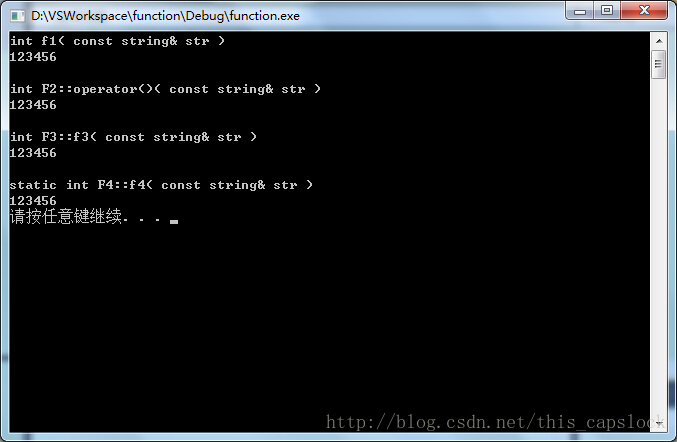
测试结果一切正常,如下图:

 浙公网安备 33010602011771号