
Do We Need Zero Training Loss After Achieving Zero Training Error?
[Ishida T., Yamane I., Sakai T., Niu G. and Sugiyama M. Do we need zero training loss after achieving zero training error? In International Conference on Machine Learnig (ICML), 2020.]( http://proceedings.mlr.press/v119/ishida20a/ishida20a.pdf#:~:text=However%2C whether zero training loss is necessary after ,training%20loss%20from%20approaching%20zero.%20This%20is%20analogous)
概
一味的最小化训练损失甚至趋于0往往会造成严重的过拟合. 作者退而求其次, 选择优化如下替代损失
一旦\(J(\theta) < b\), 原本的梯度下降就变成了梯度上升了. 作者认为, 在合理的阈值\(b\)附近振荡有利于参数的平滑.
主要内容
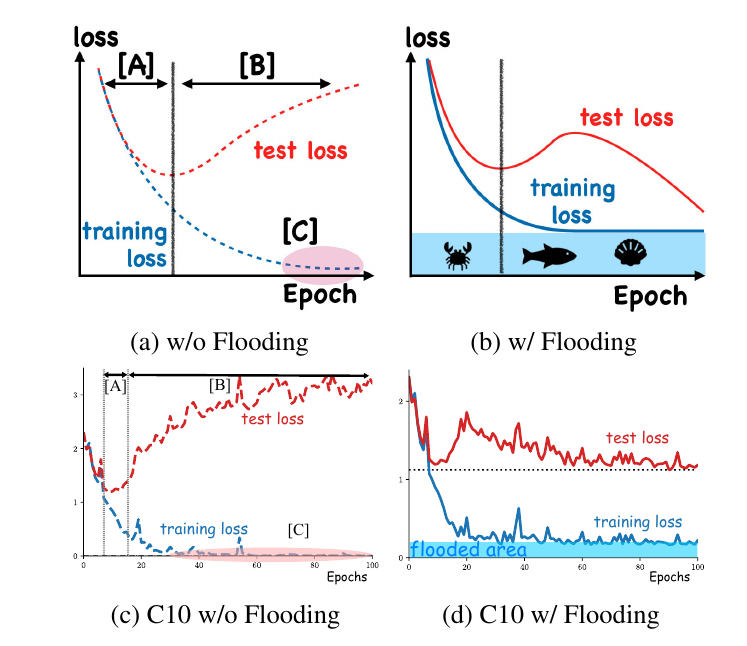
回到更实际的mini-batch的训练方式中去, 定义损失:
理想的risk为
与之对应的经验risk:
然后本文所定义的 flooding empirical risk:
优化这类损失和原来的损失差别在于, 一旦\(\hat{R}(\theta) < b\)之后, 二者的梯度就相反了, 可以预想到此时损失会在\(b\)附近振荡. 作者认为者能够帮助模型收敛到一个更加光滑的参数空间中去(因而更有利于泛化性), 这可以从作者的实验中窥探一二:

可以发现, 相较于w/o flooding 的情况, 使用 (2) 让模型的输出关于参数更加光滑和平坦了.
理论
定理1: 对于任意的\(\theta\), 若阈值\(b\)满足\(b \le R(\theta)\), 则
这个结果其实很一般, 因为一旦\(\hat{R}(\theta) > b \rightarrow \hat{R}(\theta) = \tilde{R}(\theta)\), 所以只需要考虑\(\hat{R}(\theta) < b \le R(\theta)\)的情况,
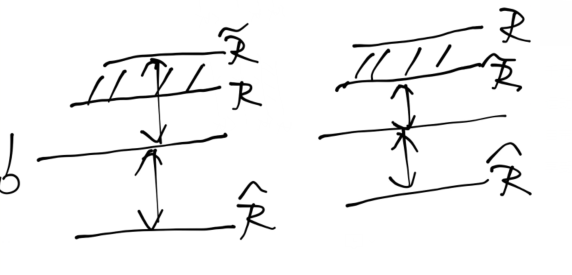
另外, 感觉后续的文章的解释更加靠谱一点.
代码
outputs = model(inputs)
loss = criterion(outputs, labels)
flood = (loss-b).abs()+b # This is it!
optimizer.zero_grad()
flood.backward()
optimizer.step()

 浙公网安备 33010602011771号